
Amber’s Age
23.06.2026
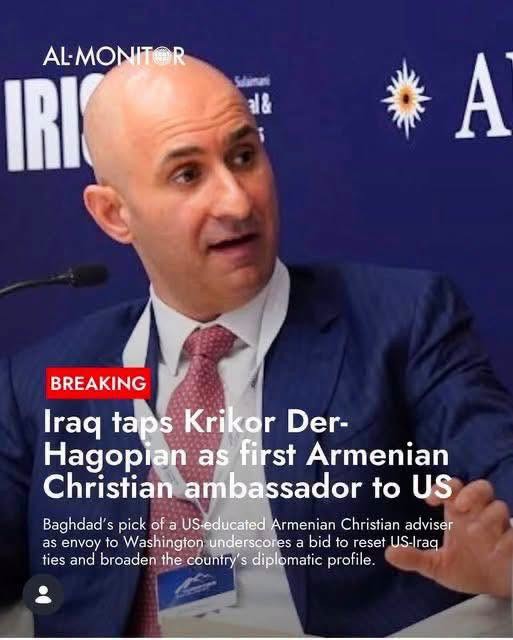
With Baghdad’s decision to send an Armenian Christian trained in the US as an envoy to Washington, the country emphasizes its desire to rebuild relations with the US and expand its diplomatic profile.
Iraq has nominated Krikor Der-Hagopian, an Armenian-Christian adviser to Prime Minister Ali al-Zaidi, as ambassador to Washington. Diplomats from the region confirmed the nomination against Al-Monitor, calling it part of Baghdad’s broader effort to re-align relations with the United States.
Der-Hagopian, an Iraqi official trained in the United States, who has already served in numerous functions – among others as an advisor to former President Barham Salih and current Prime Minister Mohammed Shia al-Sudani – is still waiting for formal approval from the Trump administration before taking office. If confirmed, the Armenian Christian would be Iraq’s first non-Shiite ambassador to Washington in decades.
It is hoped that he will receive the green light in time so he can attend the meeting between Zaidi and President Donald Trump in Washington, scheduled for the third week of July.
The 49-year-old father of three who earned a master’s degree in international relations from the Josef Korbel School of International Studies at the University of Denver is considered a sure candidate for the job. Well-informed circles familiar with Der-Hagopian report he has excelled himself in maintaining smooth relationships with successive US governments.
“I see his appointment as an extremely positive signal: The Prime Minister has decided to send probably the most qualified member of his own team — the person who understands best how Washington works,” said Victoria Taylor, a former U.S. deputy secretary of state for Iraq and Iran, who resigned in May. Left 2025 to switch to Atlantic Council, across from Al-Monitor.
“He has done excellent work in bilateral relations and collaborated with international companies,” one of the sources said. This is in line with efforts to reshape the strained US-Iraq relationship: moving away from a purely focus on security issues to an agenda centered around the “business first”.
“I’m not surprised to hear that Krikor is being considered for such a prestigious position,” says Denver-based political scientist Simon Maghakyan, a postdocal at Oxford University, who got to know Der-Hagopian while studying in Denver. “I remember him as a smart, sincere and strategic person as well as a bridge builder,” Maghakyan told Al-Monitor. The Hagopian will succeed Nizar al-Khairallah, the former Iraqi deputy foreign minister and current Iraqi ambassador to Washington. At the same time, Peter Shea – an experienced Middle East expert at the US State Department – is expected to replace another diplomat of the Ministry, Joshua Harris, as the commissioner head of the delegation in Baghdad; this applies for the time being until a regular ambassador is appointed (if such happens).
Promoting trade relations between Iraq and the U.S. is a central concern of Tom Barrack, President Trump’s newly-appointed Iraq envoy, who stopped by Baghdad last week for his first official visit since taking office. As reported by circles familiar with the talks, energy projects were at the top of the agenda at his meeting with the Iraqi Prime Minister. According to a summary of the meeting published by the U.S. Embassy in Iraq, these projects include, among other things, billions of negotiations with the US company Chevron on the development of oil fields in southern Iraq, the authorization of Elon Musk’s Starlink for high-speed Internet, floating LNG terminals in cooperation with the U.S company Excelerate Energy (with Seat in Texas) as well as the repair of an oil pipeline that connects the Kirkuk oil fields with the export terminals in Baniyas, Syria.
The message read that Zaidi and Barrack had “discussed the joint vision for the Iraqi government… to implement the Iraqi plans for the complete disarmament and disbandment of all armed groups and formations that operate outside the authority and control of the Iraqi state. “This was an open indication of the Iran-backed Shiite militias, who have enormous influence in Iraq. Successive US governments have pushed Baghdad to disarm, disband and deprive them of funding — but so far with little success.
It is estimated that Iran emerged stronger from the confrontation with Israel and the United States. Experts assume that Iran is more likely to deepen its alliance with Shiite militias in Iraq, as they have repeatedly targeted US bases and US-operated oilfields in Iraq during the four-month conflict.
The Iraqi government has set a deadline until September for the disarmament of the militias – which were originally founded to fight IS.
Barack’s support for Der-Hagopian during his tenure in Washington may prove to be crucial, “as Iraq’s importance on the political agenda there has actually diminished,” Taylor noted. “Therefore, it is a positive thing for Iraq that someone is dedicated to the issue that is so close to the president,” Taylor noted. Barrack is a longtime friend of Trump.
Barrack, who acts in the personnel union as Syria envoy and ambassador to Turkey, maintains good relations with Der-Hagopian; this was shared by a regional representative who expressed his opinion on the condition of anonymity to Al-Monitor.
Yet Der-Hagopian is facing a huge task. The US Congress is adamant to the notion that Iran controls Iraq completely. Even the massive corruption that continues to plague Iraq has not really helped his reputation among US lawmakers. “The Hagopian is an excellent seller, but he has a damaged product to offer,” an Iraq-based source that knows the new envoy personally told Al-Monitor.
Relations between Iraq and the United States have been largely focused on security issues since the fall of Saddam Hussein and the occupation of Iraq by the United States in 2003. These links have eased, however, after successive Iraqi executives – allegedly strongly at Tehran’s pressure – repeatedly demanded the withdrawal of US troops. Most of the troops had withdrawn by early 2026; several hundred have been relocated to bases in the Kurdistan region of Iraq, where they had already been exposed to drone strikes by Shiite militias before the start of the Iran war in February 2026.
Funding of the Iraqi forces by the Pentagon has also declined, as the focus shifts from the role of mentors as the leader of the global coalition against the Islamic State (Operation Inherent Resolve) to bilateral cooperation with the Iraqi military. The type and extent of the U.S. military engagement in this bilateral security relationship after the coalition dissolution must be discussed between the two sides as well as the future presence of U.S. troops in the country, according to Al-Monitor, a well-informed source informed of the state of diplomatic talks.
“The security partnership between the U.S.-Iraq will evolve with the end of Operation Inherent Resolve, and I believe that the new Iraqi ambassador can play a decisive role in determining the future outcome of this partnership,” Taylor concluded.
Jared Szuba, defense and security correspondent at Al-Monitor, contributed to this report.