
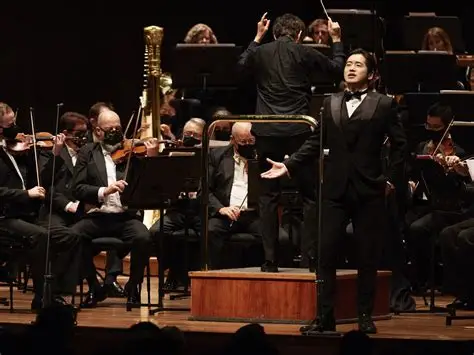
Prague, 26 May 2026 | On Wednesday 27 May, the historic building of the National Theatre will host a performance of Jules Massenet’s grand vocal-instrumental drama Marie-Magdeleine at the Prague Spring, almost exactly thirty years after it was last heard at the festival. Appearing in the leading roles of Mary Magdalene and Jesus will be stars of New York’s Metropolitan Opera and London’s Royal Opera House – Polish soprano Aleksandra Kurzak and Chinese-Australian tenor Kang Wang. The roles of Martha and Judas will be performed by soloists of the National Theatre Opera and the State Opera, Arnheiður Eiríksdóttir and František Zahradníček. The Chorus and Orchestra of the National Theatre Opera together with the Prague Philharmonic Children’s Choir will be conducted by Robert Jindra. The project has been created as a co-production between Prague Spring and the National Theatre.

Described by Massenet as a “Drame Sacré”, the work, based on a libretto by Louis Gallet, portrays the final days of Jesus’s life through the eyes of Mary Magdalene. It premiered at the Odéon Theatre in Paris on Good Friday, 11 April 1873, and sparked a minor controversy, with some critics pointing to Massenet’s tendency to portray the heroine’s relationship with the Son of God as something more than purely spiritual. Hovering on the boundary between oratorio and opera, the work reflects Massenet’s extraordinary dramatic instinct and gift for theatrical situation. This is evident in the score itself, into which he incorporated numerous stage directions – including the instruction that Jesus should not be visible during the crucifixion scene. For this reason, Marie-Magdeleine is occasionally staged rather than performed in concert form alone. Prague audiences, too, can expect a certain degree of spatial and theatrical treatment, as Robert Jindra confirms: “I myself am drawn to some kind of ‘action’ in this story, so that it is not merely a concert performance.”
This project brings together the Prague Spring festival and the National Theatre, whose collaboration dates back to the festival’s founding in 1946. Among their most historically significant joint projects were performances of five operas by Leoš Janáček in 1958, the internationally acclaimed cycle of operas and ballets by Sergei Prokofiev in 1963, and the Czech premiere of Dmitri Shostakovich’s Lady Macbeth of Mtsensk in 1965 under the musical direction of Jaroslav Krombholc, who had also presented the work at the Vienna State Opera earlier that same year. Following 1990, Prague audiences were introduced, through the collaboration between Prague Spring and the National Theatre, to productions such as The Fall of the House of Usher by Philip Glass (1999, Prague State Opera), The Death of Klinghoffer by John Adams (2003, National Theatre), Treemonisha by Scott Joplin (2005, Prague State Opera), and two important works by Benjamin Britten – Death in Venice directed by Yoshi Oida (2009, Prague State Opera) and Gloriana directed by Jiří Heřman (2012, National Theatre). In 2011, thanks to Prague Spring, the National Theatre hosted the outstanding British Hilliard Ensemble in an experimental opera by German composer Heiner Goebbels, I went to the house but did not enter, presented in the composer’s personal presence. More recent examples include the 2019 production Mozart and the Others, featuring the one-act operas Letters, Riddles and Writs by British composer Michael Nyman and The Classical Style by American composer Steven Stucky, a pupil of Karel Husa.
The partnership between these two institutions has also brought to Prague a number of prestigious guest appearances by leading European opera companies, including the Komische Oper Berlin in 1956 and the Berlin State Opera, which in 1959 presented five productions at the Smetana Theatre: Ariodante by George Frideric Handel, Lohengrin by Richard Wagner, Elektra by Richard Strauss, L’incoronazione di Poppea by Claudio Monteverdi, and the contemporary ballet New Odyssey. In 1979, the Vienna State Opera appeared at Prague Spring under the legendary conductor Karl Böhm, with Edita Gruberová singing the role of Zerbinetta in Ariadne auf Naxos. One of the most ambitious projects in the festival’s history came in 2005 with a production of Wagner’s Der Ring des Nibelungen in co-production with Deutsche Oper am Rhein. From the festival’s more recent history, mention should also be made of the successful Czech premiere of the opera Dorian Gray by composer Ľubica Čekovská, performed by the Slovak National Theatre in 2015.
For Polish soprano Aleksandra Kurzak, who will make her role debut as Mary Magdalene, Massenet’s treatment of this biblical story is above all a story of love. “I am a Catholic, a Christian. But if I set my faith aside for a moment and think about it rationally, of course I ask myself why a woman of, let us say, somewhat questionable reputation stood beneath Jesus’s cross together with his mother. What is the message behind that? Perhaps she truly meant more to Jesus than just another person? Or perhaps she was simply ‘labelled’ in this way later, when the Church was being built? We do not know. But it is a beautiful story that offers hope – that even if you reach rock bottom in life, you can change, you can become a better person, and help can always come. And that is a beautiful message! What Jesus Christ truly gave us was love. It is about nothing else. If we look at it purely from the perspective of Christianity, it is about love. About loving your neighbour as yourself,” says Aleksandra Kurzak. Kurzak first appeared at the Metropolitan Opera in 2004 and shortly afterwards made her debut at London’s Royal Opera House. She has continued to return to both stages with unwavering regularity ever since. Her career also includes numerous acclaimed productions at Teatro alla Scala, the Vienna State Opera, the Bavarian State Opera, the Berlin State Opera and the Salzburg Festival.
Chinese-Australian tenor Kang Wang is currently one of the brightest stars of the rising generation of singers. He completed the prestigious Lindemann Young Artist Development Program at the Metropolitan Opera and, in 2017, became a finalist in one of the world’s most demanding vocal competitions, BBC Cardiff Singer of the World. In the current season alone, he has appeared at the Metropolitan Opera, the Vienna State Opera, San Francisco Opera and the Bavarian State Opera. Critics describe his voice as “warm, moving, penetrating, and above all majestically resonant”. Jesus will be his first Massenet role. “I assumed that the first Massenet opera I would study would perhaps be Werther or Manon. And instead, it is Jesus! I never imagined that one day in my career I would sing and portray Jesus!”
The large-scale forces of around 150 performers will be led by the National Theatre’s Music Director Robert Jindra: “Marie-Magdeleine has been on my mind since my student years. That was when I fell in love with Massenet thanks to Hérodiade. Marie-Magdeleine was love at first hearing. Musically, I feel extraordinarily close to it – it is my world, one that I thoroughly enjoy. The ending of Marie-Magdeleine, building towards a kind of apotheosis, is simply overwhelming,” he says of his relationship with the work.
The 2026 performance will mark only the second presentation of the work in the history of the Prague Spring International Music Festival. In 1996, it was performed twice as part of the European Cathedral Concerts series by the Janáček Philharmonic Ostrava and the Kühn Choir of Prague under the baton of Petr Vronský. The solo parts were sung by Eva Dřízgová (Mary Magdalene), Erika Šporerová (Martha), Valerij Popov (Jesus) and Vladimír Chmelo (Judas).
_____________________________
Jules Massenet: Marie-Magdeleine, a sacred drama in three acts
27 May, 20.00, National Theatre
Project details: https://festival.cz/en/programme/marie-magdeleine-national-theatre-27-5/