
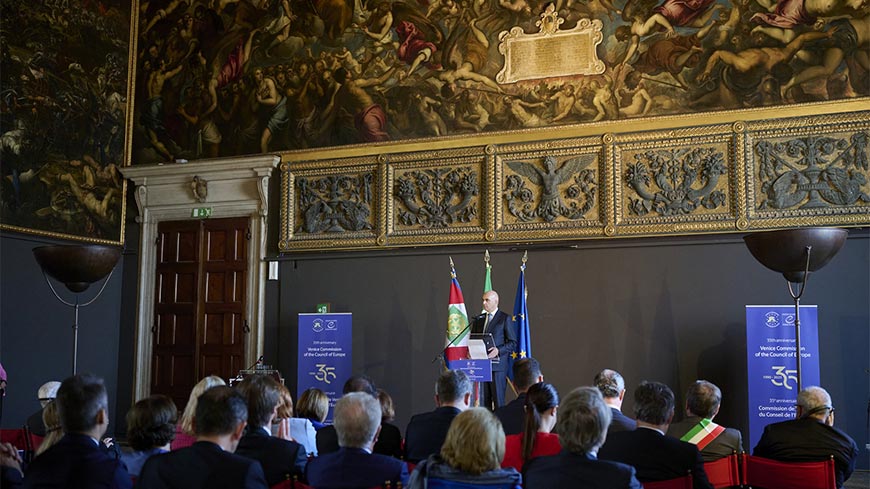
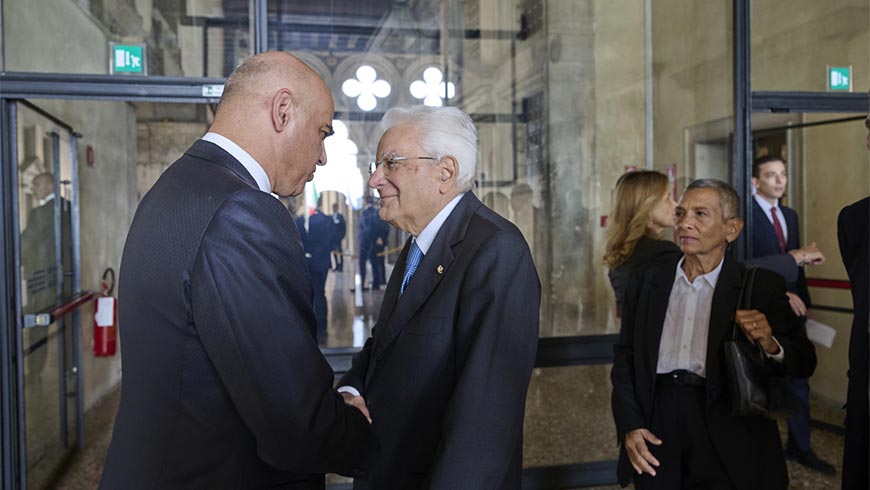
The European Commission for Democracy through Law (better known as the Venice Commission), the Council of Europe’s advisory body on constitutional matters, celebrates its 35th anniversary of advising countries on constitutional and legal reforms with a ceremony on 11 October in Venice (Palazzo Ducale, Sala dello Scrutinio, 11 am-3 pm), in the presence of the President of the Italian Republic Sergio Mattarella. Secretary General Alain Berset provides a welcome address, following institutional greetings by the Mayor of Venice Luigi Brugnaro.
The Opening address delivered by Claire Bazy Malaurie, President of the Venice Commission is followed by speeches by Maia Sandu, President of the Republic of Moldova, Gordana Siljanovska-Davkova, President of the Republic of North Macedonia and by Antonio Tajani, Vice-President of the Council of Ministers and Minister for Foreign Affairs and International Co-operation of Italy.
A keynote speech “Democracy renewed: Lessons from transitions, today’s challenges of backsliding and our commitment for tomorrow” is given by Egils Levits, Former President of the Republic of Latvia and former judge of the European Court of Human Rights. Clifton Grima, Minister for Education, Sport, Youth, Research and Innovation of Malta on behalf of the Presidency of Malta of the Committee of Ministers, Theodoros Rousopoulos, President of the Parliamentary Assembly, Marc Cools, President of the Congress of Local and Regional Authorities, Ivana Jelić, Vice-President of the European Court of Human Rights and Michael O’Flaherty, Commissioner for Human Rights also adresses the audience.
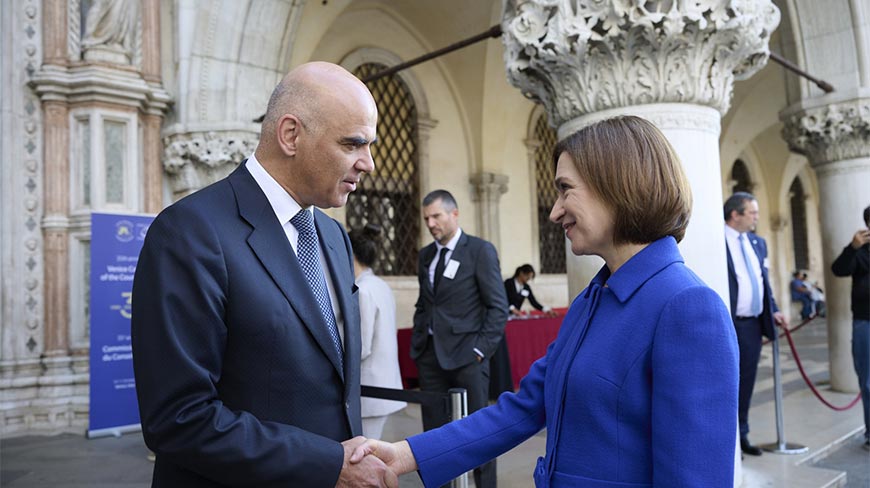
The event provides a unique opportunity to assess the manner in which democratic institutions have developed in Council of Europe member states and beyond over the last 35 years, to consider the achievements of the Venice Commission’s work of assistance in constitutional design, and to reflect on how to pursue democratic development in the future.
On the same day, the exhibition entitled “La Democrazia attraverso il Diritto. Dalla Serenissima Repubblica alla Commissione di Venezia del Consiglio d’Europa” (“Democracy through law: from the Serenissima Republic to the Venice Commission of the Council of Europe”) is inaugurated (open until January 6, 2026, in Appartamenti del Doge, Palazzo Ducale).
The exhibition, a collaboration between the Venice Commission, the Council of Europe Programme Office in Venice, the Soprintendenza Archivistica e Bibliografica del Veneto e Trentino – Alto Adige, l’Archivio di Stato di Venezia, Fondazione Musei Civici di Venezia (MUVE) and il Consiglio Regionale del Veneto, offers a fascinating journey through the history of democracy and the rule of law, from the forerunner Serenissima Republic of Venice to the Council of Europe member states of today, under the expert eye of the Venice Commission.
Background information
The Venice Commission comprises independent legal experts (constitutional and ordinary judges, law and political science professors, ombudspersons, electoral specialists) from its 61 member States (all 46 Council of Europe member states and 15 countries in Africa, Asia and the Americas). It provides impartial advice on legal and constitutional reforms, in the form of opinions, upon request from member States or organs of the Council of Europe (or certain other European or international institutions), to assist states in finding effective solutions to constitutional and legal issues while respecting European and international standards in the field of democracy, human rights and the rule of law. The Commission’s plenary sessions are held in Venice at the Scuola Grande di San Giovanni Evangelista, four times a year. Claire Bazy Malaurie, former member of the Constitutional Council of France, is currently the President of the Venice Commission.
The Commission was set up on 10 May 1990 by 18 Council of Europe member States with the conviction that sustainable democracy could only be built if this was grounded on a sound constitutional framework based on the rule of law. Antonio La Pergola, former Minister of (European) Community Policy of Italy, was the Venice Commission’s founder and first President.
Since 1990, the Venice Commission has adopted more than 1200 country-specific opinions and general reports, becoming an essential point of reference for professional and independent expert advice in constitution-making.
Opinions of the Venice Commission on specific countries have covered a wide range of topics: the system of checks and balances, and the relations amongst different branches of power, the territorial organisation of the States, principles of the rule of law, fundamental rights and freedoms, constitutional justice, the judiciary and the prosecution service, status and powers of ombudspersons, reforms of the electoral system, regulations on the political parties and referenda. At the request of a constitutional court or the European Court of Human Rights, the Commission may also provide amicus curiae briefs on comparative constitutional and international law issues related to a case under consideration.
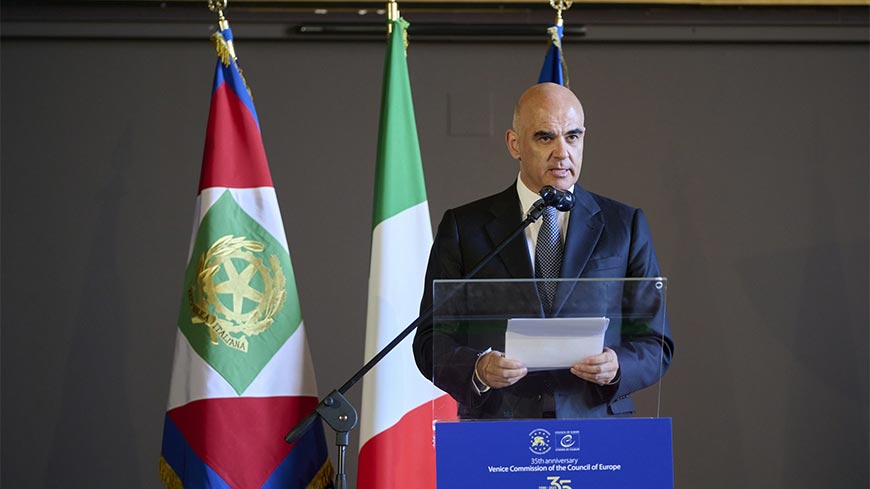
Remarks by Mr Alain Berset, Secretary General of the Council of Europe
Venice, 11.10.2025 – “Thirty-five years ago, in the Eternal City, Europe made a bold but necessary decision. To create an impartial advisory body to bring constitutions into dialogue. Across borders. Above divisions. And to do it in the only place it could be done: the Council of Europe.
At first, there was resistance. Making history never comes easy. But Antonio La Pergola, with Italy’s support, saw that change was coming.
Democracy, human rights, and the rule of law can only rest on constitutional foundations. And those foundations are stronger when they are shared. That was the insight of 1990. When nations reclaimed their freedom.
And from it flowed the Venice Commission’s first task. To help young democracies take root. Its fingerprints are everywhere. In the constitutions of Central and Eastern Europe. In electoral codes from the Baltics to the Western Balkans. In the independence of judiciaries across the continent. The Venice Commission gave Europe a common vocabulary of democracy.
Then came the second task. To guard against relapse. When governments tried to weaken courts or bend parliaments, the Venice Commission acted as a counterweight.
Its principles on judicial independence have been cited by the European Court of Human Rights. By the Court of Justice of the European Union – and even beyond. The Venice Commission is our best ambassador. It has helped guide transitions in South Africa. Inspired reforms in Tunisia. And shaped judicial debates across Latin America. With 61 member states, it is a European invention with a global influence.
And now we have entered a third phase. One defined by democracy backsliding, external threats, and new challenges. Dangers clearly identified in the Reykjavík Declaration. And visible every day. I am talking about courts under attack. Parliaments weakened. Independent media silenced. Foreign influence. And the influence of money. Disinformation campaigns. Fueled by artificial intelligence. The climate crisis. Behind it all: double standards and contempt for the international rule of law.
The Venice Commission is already at work. With its Rule of Law Checklist. Its Code of Good Practice in Electoral Matters. Its declaration on AI. Its ongoing mapping of legislation on foreign influence — and on the influence of money on democracy. Its opinions on judicial independence in Ukraine in wartime.
These are instruments of democratic security. Our values as the first line of defence. Because today, security is not just military. Rearmament without democratic safeguards is dangerous. Tomorrow, extremists could turn that power against our values.
Thirty-five years ago, the Venice Commission of the Council of Europe was born against the odds. It helped new democracies find their voice. It has helped all of us defend the rule of law. And now it confronts new dangers head-on. At stake? Nothing less than the security of democracy. This is the task of our time. Our strength. Our unity. Our future.”
orer.eu