

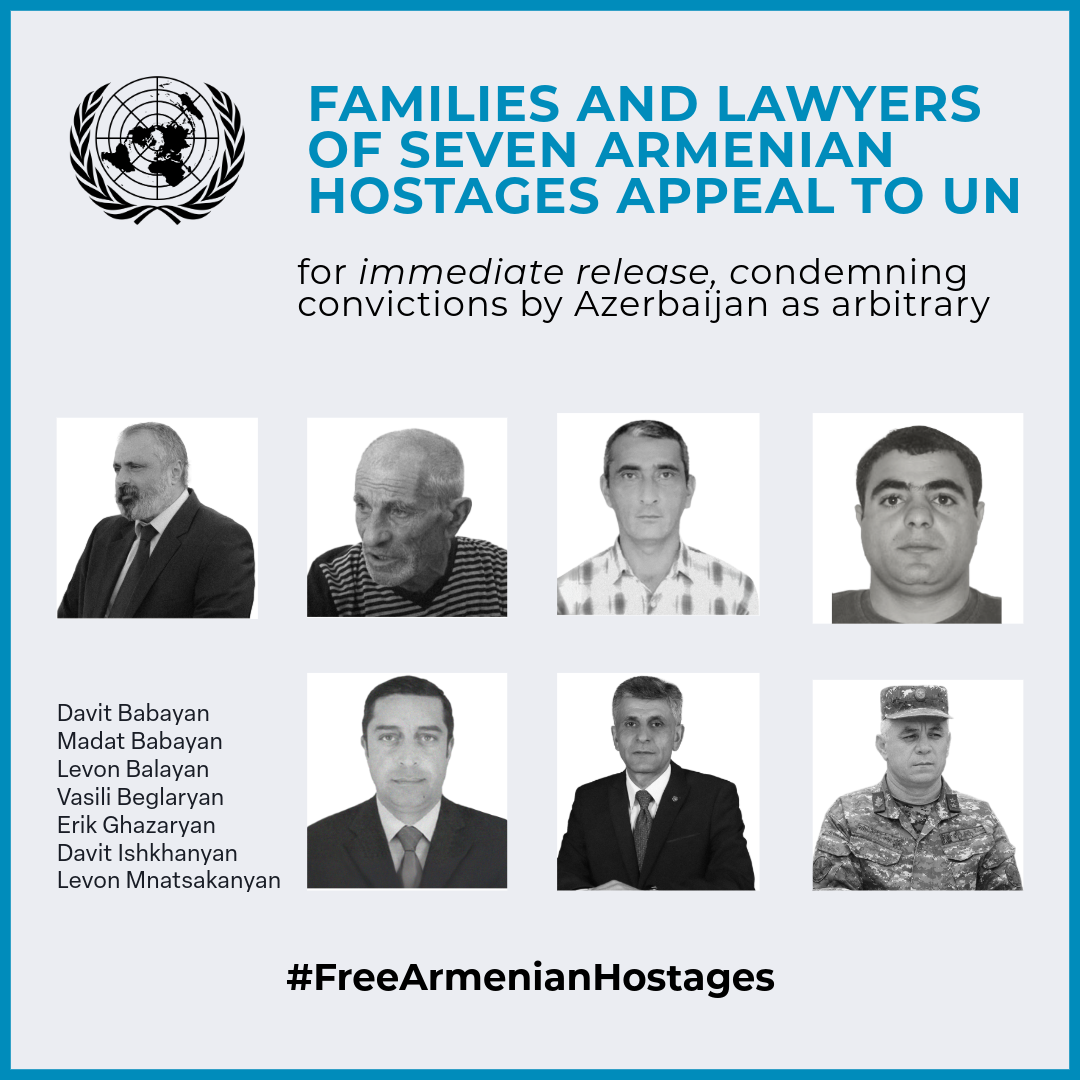
International lawyers representing the families of seven Armenian hostages currently imprisoned in Azerbaijan have filed a formal petition with the United Nations Working Group on Arbitrary Detention (WGAD), calling for their immediate and unconditional release.
Dated 24 April—the annual day of remembrance for the victims of the 1915 Armenian Genocide—the petition requests the annulment of their convictions, arguing that they are the result of severe violations of international law. The petition also requests to thrown out their conviction because it was handed down by a Azerbaijani military court. The seven were convicted for civilian, not military crimes. As such, under international law, their cases should have been heard in a civilian court.
Who Are the Seven Men?
The hostages — Davit Babayan, Madat Babayan, Levon Balayan, Vasili Beglaryan, Erik Ghazaryan, Davit Ishkhanyan, and Levon Mnatsakanyan — are Armenian citizens who were captured by Azerbaijani forces between 19 September and 3 October 2023, in the immediate aftermath of Azerbaijan’s military offensive against Nagorno-Karabakh (Artsakh). They comprise former political leaders, military servicemen, and one civilian.
Three of the hostages — Davit Ishkhanyan (former President of the National Assembly of Artsakh), Davit Babayan (former Foreign Minister), and Levon Mnatsakanyan (former Minister of Defense and Commander of the Defense Army) —were sentenced to life imprisonment on 5 February 2026 by the Baku Military Court. The remaining four received sentences ranging from 15 to 19 years. As of today, the men have been held in Baku Prison for between 934 and 948 days.
Although seven of the 19 hostages were selected for this stage of the petition, all Armenian captives meet the criteria for arbitrary detention and the WGAD opinion will be relevant for the entire group.
The Petition Arguments
The WGAD is a body of independent legal experts mandated by the UN Human Rights Council to investigate cases of arbitrary detention worldwide. This petition has been filed because the families and legal teams of the detainees have no other viable means to appeal the men’s wrongful convictions within Azerbaijan.
The petitioners argue that the detention of all seven hostages is arbitrary according to multiple criteria recognized by the Working Group:
- No valid legal basis. The detainees were captured during an armed conflict that meets the international legal definition of an international armed conflict under the Geneva Conventions. As combatants, they should have been recognized as prisoners of war (POWs), entitled to protection and repatriation under the Third Geneva Convention. Instead, Azerbaijan falsely prosecuted them for ordinary crimes—including terrorism, illegal weapons possession, and genocide — charges that cannot lawfully be brought against combatants acting within the laws of war.
- Criminalization of political beliefs. Davit Babayan and Davit Ishkhanyan spent decades advocating peacefully for the self-determination of Nagorno-Karabakh’s Armenian population. Just days before their arrests, Azerbaijani President Ilham Aliyev publicly described the Artsakh leadership as “criminals.” The petitioners argue their detention is intended to silence political dissent, in direct violation of the rights to freedom of expression, opinion, and association guaranteed under international law.
- Fundamentally unfair trials. The hostages were tried collectively alongside eight other Armenian defendants in closed military proceedings, without access to lawyers of their own choosing. Five of the seven refused to confirm statements they had previously made during the investigation, raising serious concerns among outside observers regarding the potential use of coercion and torture. Furthermore, the verdicts have not yet been formally communicated to the convicted men, effectively preventing them from filing an appeal.
- Denial of humanitarian access. The International Committee of the Red Cross (ICRC), which had been visiting Armenian prisoners in Azerbaijan, was expelled from the country in September 2025, removing the last independent oversight mechanism for the detainees.
- Unlawful mercenary charges. Six of the seven prisoners named in this petition have been charged with mercenary activity. The petitioners argue this charge is legally impossible to sustain: under both international law and Azerbaijan’s own Criminal Code, an individual cannot be a mercenary if they are a national of, or permanent resident in, a party to the conflict. All seven hostages are Armenian nationals who lived in Nagorno-Karabakh.
- Discrimination based on ethnicity and political opinion. The UN, the European Court of Human Rights, and multiple international bodies have documented a systemic pattern of anti-Armenian discrimination in Azerbaijan, including within its justice system. The petitioners argue that the men’s prosecution reflects this discriminatory pattern and that they would not have been targeted, prosecuted, or kept in detention were it not for their Armenian identity and their association with Artsakh’s governing institutions.
The petition was submitted to the UN Working Group on Arbitrary Detention pursuant to UN Human Rights Council Resolutions 1997/50, 2000/36, 2003/31, 6/4, 15/18, 20/16, 24/7, 33/30, 42/22, and 51/8.
The Broader Context
The seven individuals are among 19 Armenian captives currently held in Azerbaijan following the conflicts of 2020 and 2023. Their plight has been repeatedly raised by the United Nations, the European Parliament, the European Court of Human Rights, Amnesty International, and other major international institutions, all of which have called for their release and expressed deep concern regarding their conditions of detention.
On 3 March 2025, the UN High Commissioner for Human Rights stated that “all those arbitrarily detained in Azerbaijan, including ethnic Armenians, must be released immediately, and fair trial rights must be fully respected.” The European Parliament has passed six resolutions on the matter since 2021, most recently in March 2025. Additionally, the International Court of Justice has issued multiple orders requiring Azerbaijan to protect Armenian detainees from harm and ensure their equality before the law—orders with which Azerbaijan has failed to comply.
What the Petitioners Are Asking
The petition asks the UN Working Group on Arbitrary Detention to:
1. Issue a formal opinion declaring that the detention of the hostages is arbitrary;
2. Call for their immediate release and demand compensation for the harm caused by their prolonged, unlawful detention;
3. Request access for Working Group representatives to visit the Armenian hostages in Baku Prison pending their release.
About the Petitioners
With authorization of the captives’ families, the petition was submitted jointly by:
- Siranush Sahakyan – Attorney (Yerevan, Armenia)
- Artak Beglaryan – President of the Artsakh Union (Yerevan, Armenia)
- Aitor Martínez Jiménez – Attorney (Madrid, Spain)
- Megan Chourreau-Lyon – Attorney (Paris, France)
- Irene Massimino – Attorney (Buenos Aires, Argentina)
- The petition was submitted to the UN Working Group on Arbitrary Detention pursuant to UN Human Rights Council Resolutions 1997/50, 2000/36, 2003/31, 6/4, 15/18, 20/16, 24/7, 33/30, 42/22 and 51/8.