
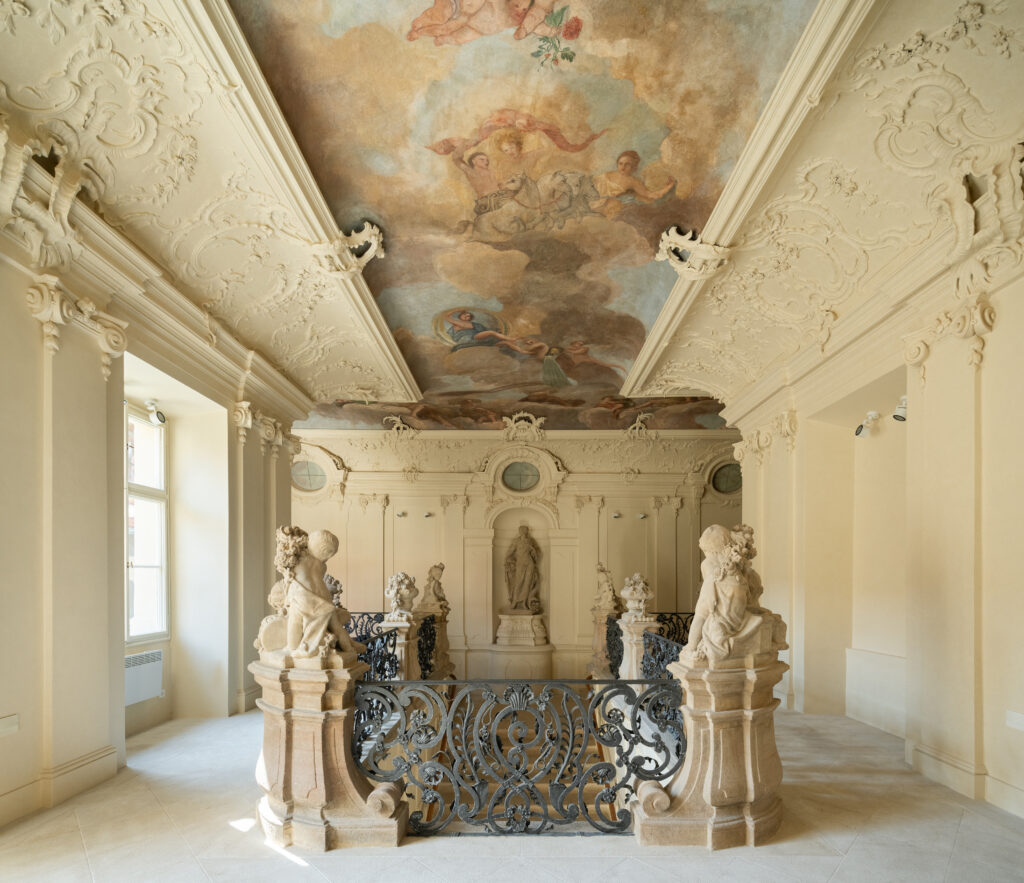
In the beautifully restored Savarin Palace in the heart of historic Prague,
the Mucha Museum celebrates the legacy of Alphonse Mucha, a defining
figure of the Art Nouveau.
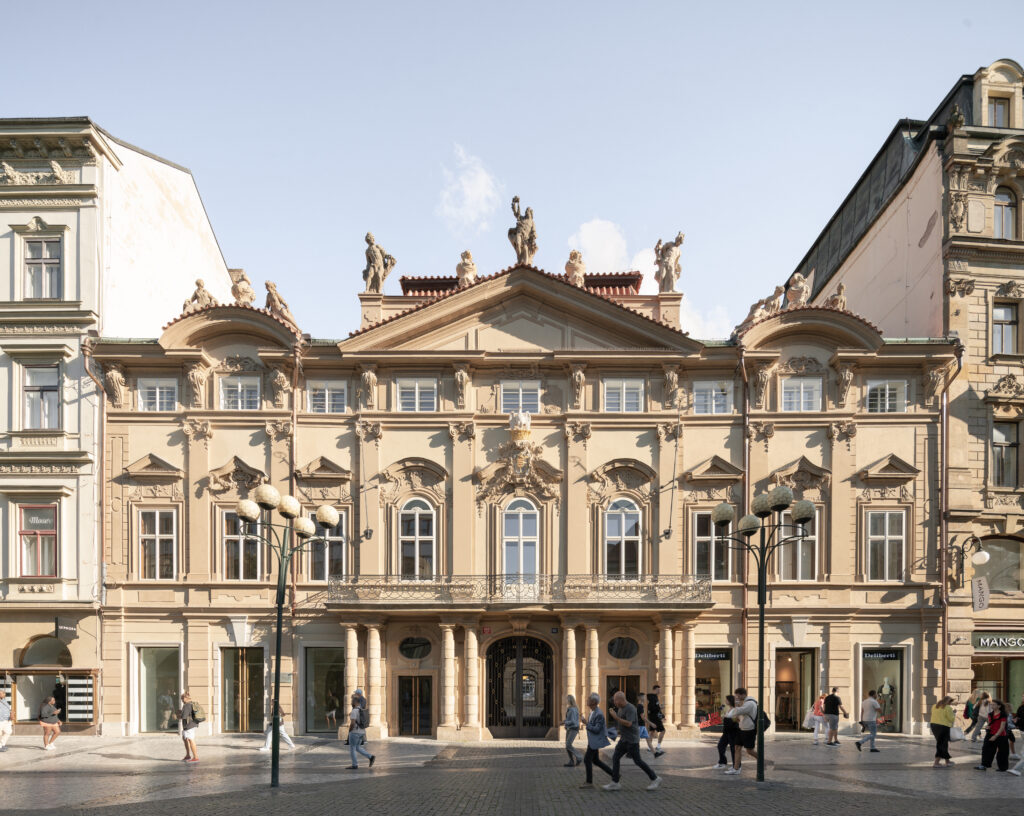
The Savarin Palace, Na Příkopě Street, Prague. Photo © Crestyl
23 January 2025, Prague, Czech Republic – The Mucha Museum, a new arts destination
dedicated to the work of world-renowned Czech artist Alphonse Mucha (1860–1939),
officially opens its doors on Monday, 24 February 2025.
Situated in the centre of historic Prague within the breathtaking Baroque setting of the
Savarin Palace, which has been exquisitely restored by the Czech property developer
Crestyl in close consultation with heritage institutions, the Mucha Museum promises to be a new cultural landmark for lovers of art and history alike, exploring the work and life of one of
the world’s best known Czech artists. The museum represents an important first step in the
development of the Thomas Heatherwick-designed Savarin project, as well as a new era for
Mucha’s legacy, with the creation of a bespoke space for his monumental masterpiece The
Slav Epic (1912–1926) in Prague when the Savarin project officially opens to the public.
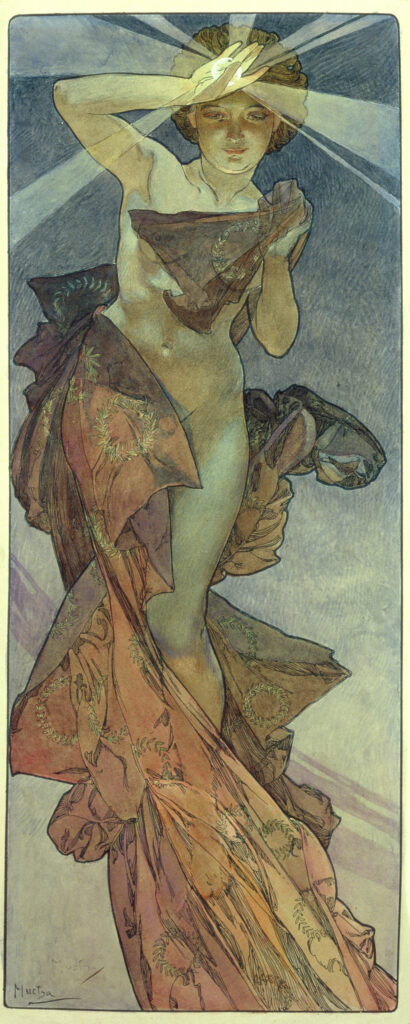
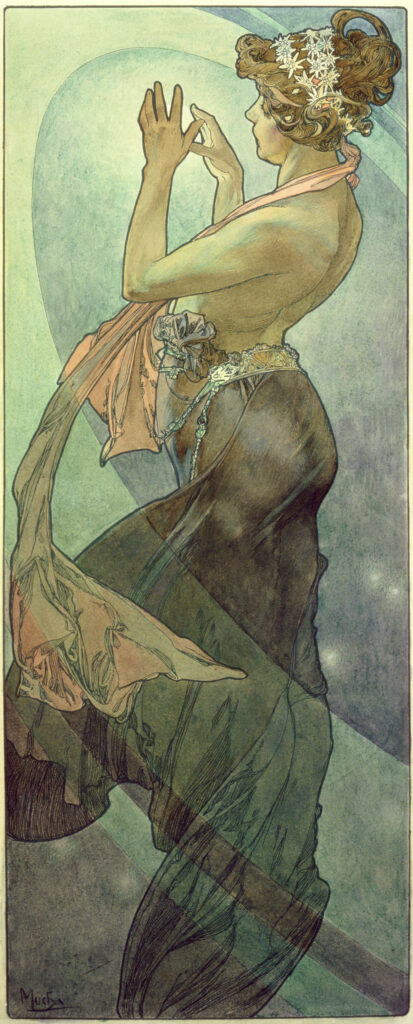
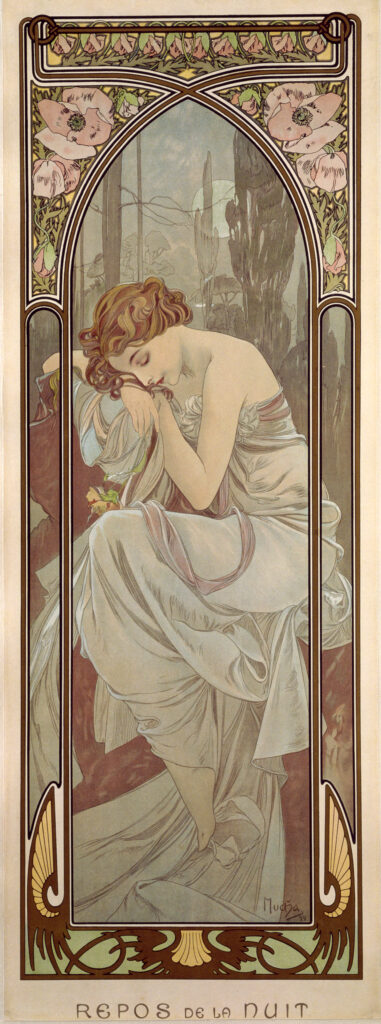
Born in a small town in Moravia, Mucha rose to fame in Paris in the 1890s when his
lithograph posters for Sarah Bernhardt, the most celebrated French actress of the day,
became immediately iconic. Their sinuous lines, organic forms and muted palette were
characterised as ‘Le Style Mucha’ and became synonymous with the newly emerging
decorative style of the time—Art Nouveau. Regarded as “the greatest decorative artist in the
world”, Mucha’s designs were extraordinarily influential; he was the one of the earliest artists
to gain international acclaim in both Europe and America, and his graphic genius has
shaped our visual language, continuing to influence and inspire artists from diverse
movements and cultures, including Hollywood, tattoo art, Manga and street art.
While the posters Mucha produced in Paris have always been his most popular works, Mucha was
an unusually versatile artist: a painter, sculptor, photographer and designer in a wide range of
media, as well as an inspiring teacher and philosopher. An avowed “artist for the people”,
for Mucha, art was a language to express his ideal of drawing people together to promote
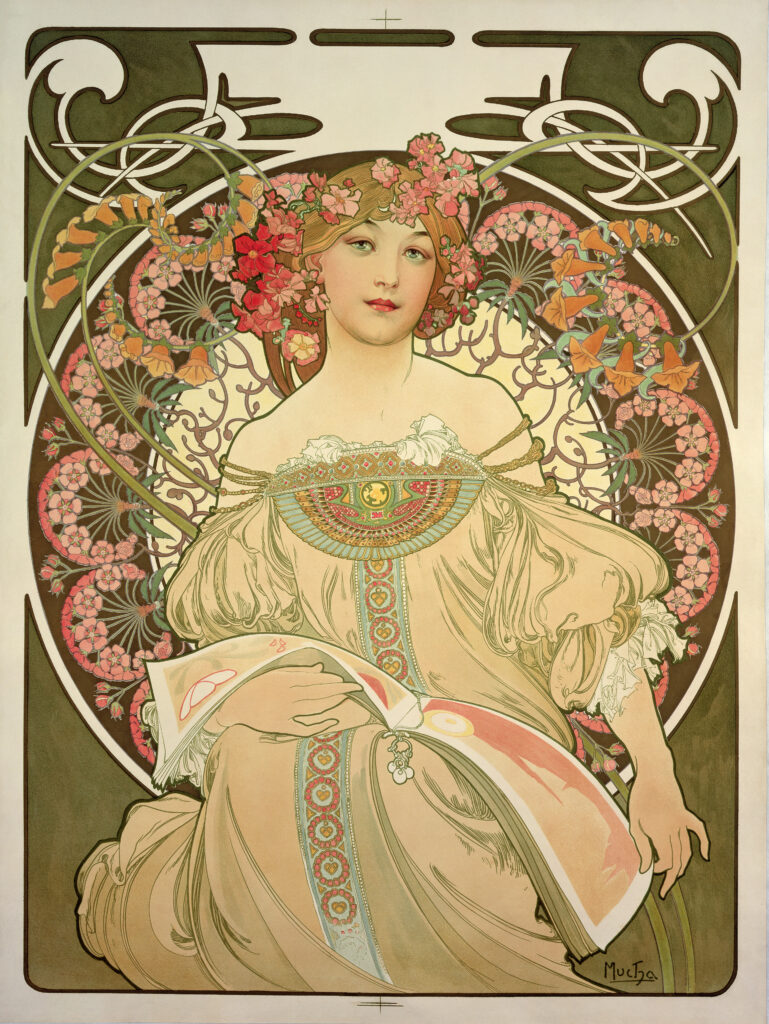
progress and peace. Presenting the permanent exhibition Alphonse Mucha: Art Nouveau & Utopia, the museum presents some ninety works from the Mucha Trust Collection, including paintings, posters, drawings, books and photographs, along with immersive and digital projections. It explores Mucha’s artistic and spiritual journey,
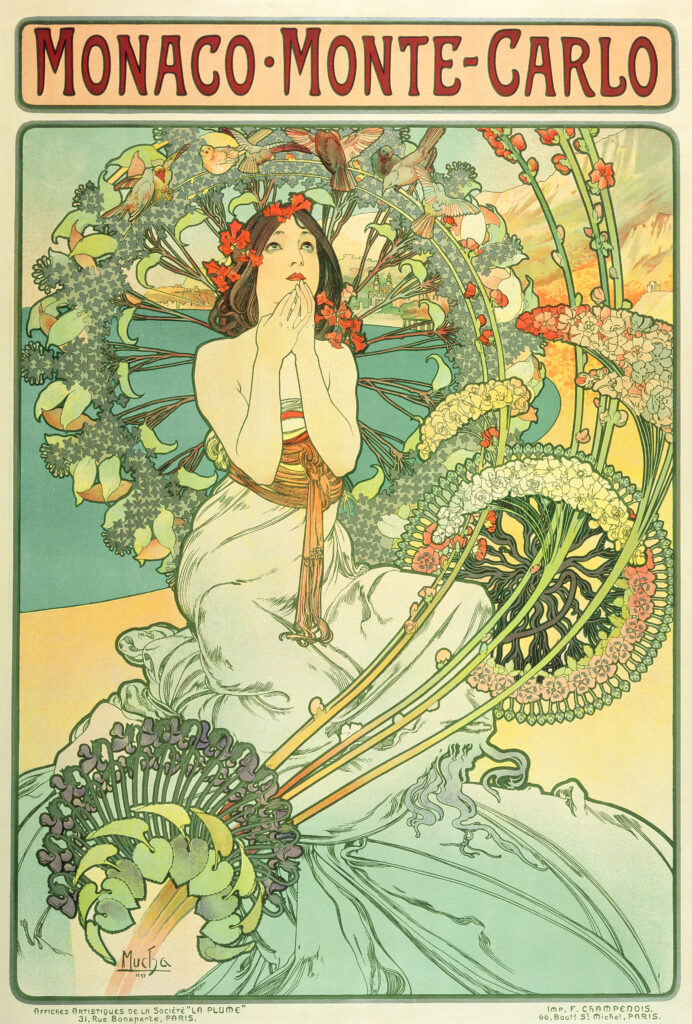
from his most popular Art Nouveau poster designs — which he conceived as an alternative
art form to make the beauty of art accessible to the wider public — through to the creation of his
masterpiece, The Slav Epic, and the ideological vision that underpinned these. The artist
explained: “The purpose of my work has never been to break down, but always to construct, to
build bridges. Because we must all hope that humanity will draw together, and the easier it will
be the more they understand each other.”
Marcus Mucha, great-grandson of Alphonse Mucha and Executive Director of the Mucha Foundation, shared his excitement for the opening:
“Our aim is not only to showcase Mucha’s well-known masterpieces, but also to share the
wealth of artistic works from the Mucha Family Collection that reveal his extraordinary artistic
journey from a small village in the Austro-Hungarian Empire where his love of Slavic culture
was formed, to fin-de-siècle Paris where he forged a style that won over the world, to
America where was a celebrated artist and friend to presidents, and its culmination with a
return to his homeland. We’re thrilled to present an overview of Mucha’s work into this
exceptional space that – much like my great-grandfather and his art — has played an
important role in Czech history, and which has been sensitively restored to its former glory
by Crestyl. We’re delighted too that Eva Jiřičná, one of the Czech Republic’s most renowned
architects, and her company AI DESIGN, have created the museum’s exhibition space.”
Simon Johnson, CEO of Crestyl, commented:
“The Savarin Palace is an important cultural monument of the Czech Republic, being not
only one of the most beautiful Baroque palaces in Prague, but also having been the home of
a famous social club frequented by prominent Czech intellectuals during the First Republic.
Yet it suffered from misuse and had fallen into disrepair. Rescuing what was until recently a
casino and replacing it with a museum for one of the most important Czech artists perfectly
illustrates what’s at the heart of the Savarin project. We are proud to be part of an initiative
that brings Alphonse Mucha’s remarkable body of work to the public in a spectacular new
setting. The Mucha Museum will be a centrepiece of Prague’s cultural landscape, and it
represents a major step in transforming the Thomas Heatherwick-designed Savarin project
into a thriving destination for both local and international visitors.”
Tomoko Sato, Art historian and curator of the Mucha Foundation, explains what it means to
see Mucha’s work in this context:
“The Savarin Palace provides the ideal stage to explore Mucha’s work. Stepping inside the
palace, it is immediately clear that there is a direct connection between the artistic spirit that
infuses its Baroque paintings, sculptures and architecture and that of Mucha’s art. This can
be seen across his entire career: from his earliest decorative commissions to the Moravian
symbolism that informed Le Style Mucha, through to the dynamic compositions of his The
Slav Epic, his art intentionally asserted his Czech heritage. Mucha’s spiritual home is here,
in this glorious 18th-century palace in the heart of Prague, and we’re delighted that the
Czech public, seasoned Mucha lovers and new audiences alike have the opportunity to
encounter his work in this context.”
The exhibition design for the Mucha Museum has been planned by the renowned Czech
architectural studio AI DESIGN, who in 2022 cooperated with the Mucha Foundation to
design the exhibition Mucha: The Family Collection, presented in cooperation with the Czech
Senate at Prague’s Waldstein Riding School as the cultural centrepiece of the Czech
Republic’s rotating presidency of the European Union.
Eva Jiřičná, co-founder of AI DESIGN, said:
“To design a museum exhibition is one of the most pleasant works an architect can think of
and to participate in the design of Alphonse Mucha’s museum inside an extraordinary
historic monument — the Savarin Palace in the heart of Prague — is a real treat. It is a
challenge to marry the 18th-century expressive and grandiose interior with the work of this
internationally renowned artist and sculptor, so integral to the period in which he lived and
created, and whose multifaceted talent is clearly rooted in his country of origin. It has been
our aim to create a harmony between the two completely different worlds and personalities,
and we hope the immersive environment not only honours Mucha’s legacy but also fosters a
deeper appreciation for the intricate relationship between art design and cultural history.”
The Mucha Museum officially opens in the Savarin Palace in Prague on 24 February 2025
with Alphonse Mucha: Art Nouveau & Utopia. The exhibition will be accompanied by a
richly illustrated full-colour catalogue edited by curator Tomoko Sato. The museum shop will
offer a selection of custom designed homewares, books, craft items, jewellery, toys,
ceramics, fashion, accessories and textiles, all officially authorised by the Mucha
Foundation.
For more information about the Mucha Museum, please visit the website:
https://mucha.eu/.
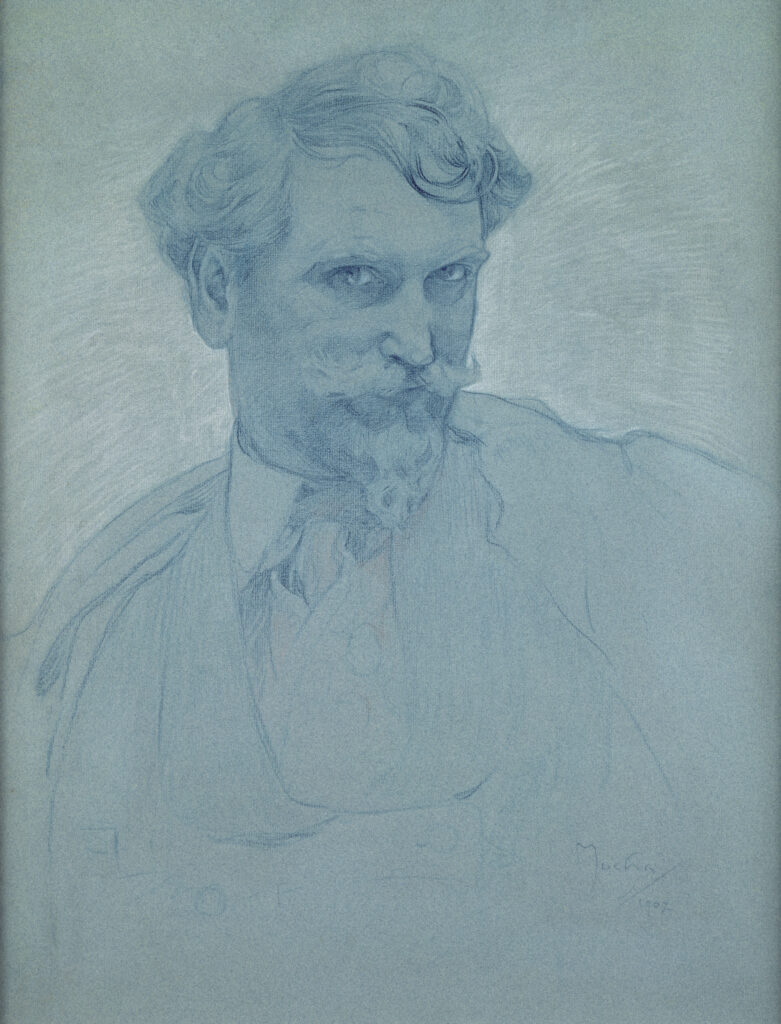
About Alphonse Mucha
Alphonse Mucha (1860–1939) was a Czech artist who defined the style of the ‘Art Nouveau’
era. Living in Paris, he became an overnight sensation with his poster of the world-famous
actress Sarah Bernhardt in the play “Gismonda”. With his new style, characterised by
elegantly curving lines, natural motifs and graceful women, his advertising posters and
decorative panels took over the streets and living rooms of Paris. By 1900, he was one of
the most famous artists in the world. In the latter part of his life, he put his artistic talents at
the service of the newly established country of Czechoslovakia. His artwork continues to
inspire artists all over the globe, and his visual language still influences the way the world
looks today: in rock and roll posters, Manga and even superhero movies and videogames.
About the Mucha Foundation
The Mucha Foundation was founded in 1992 by the artist Alphonse Mucha’s grandson John
Mucha and the artist’s daughter-in-law, Geraldine Thomsen Mucha. The Mucha Foundation
protects and preserves the Mucha Family Collection, the largest and most comprehensive
collection of Mucha’s works worldwide, and promotes Alphonse Mucha’s artistic heritage.
Over the years, the Mucha Foundation has held more than 90 exhibitions across the world,
at which more than 6,500,000 visitors have become acquainted not only with the work of
Alphonse Mucha, but also with Czech culture. The Mucha Foundation is internationally
recognized as the authority on the life and work of Alphonse Mucha. The Mucha
Foundation’s President is John Mucha and its Executive Director is the artist’s great-
grandson Marcus Mucha.
Current and upcoming exhibitions of Mucha’s works include: Grand Palais Immersif –
Taubman Museum of Art, Roanoke, Virginia, USA (opened 24 October 2024); Grand Palais
Immersif – Bunkamura Hikarie Hall, Tokyo, Japan (opened 3 December 2024); and Mucha
Trail 2025; Expo 2025 Osaka, Japan (opens 13 April 2025). Timeless Mucha: The Magic of
Line, a solo touring exhibition of Mucha’s work, will be on show at The Phillips Collection in
Washington DC, USA (opens 22 February 2025).
About Tomoko Sato
Tomoko Sato studied History of Art and Architecture at the University of Reading, and
Museology at the University of Manchester. Formerly Curator at the Barbican Art Gallery in
London, she has been Curator of the Mucha Foundation since 2007. She has curated
numerous exhibitions on Alphonse Mucha as well as on modern art, design, and
photography.
About Crestyl
The Crestyl development and financial group has been active in Central Europe for almost
30 years. Considered one of the region’s leading multi-sector developers and well known for
its commitment to quality, design, superior workmanship, and use of first-class materials,
Crestyl’s current portfolio includes over 50 projects in the Czech Republic and Poland, where
it operates under the Spravia brand. Among its most significant Czech projects are the
reconstruction and completion of the Savarin Complex, the newly emerging Hagibor district
near the Želivského metro station, and Dornych in Brno.
About the Savarin project
The 15.000 m 2 Savarin project is one of the largest urban development projects in the centre
of Prague. It consists of four interconnected parts, including the careful reconstruction of
existing historic buildings and the creation of a completely new public space with greenery,
courtyard open space and commercial areas. The overall architectural vision and form is in
the hands of British architect Thomas Heatherwick and construction started in 2021 with the
renovation of the Baroque Savarin Palace, which was officially completed in September 2024.
orer.eu