
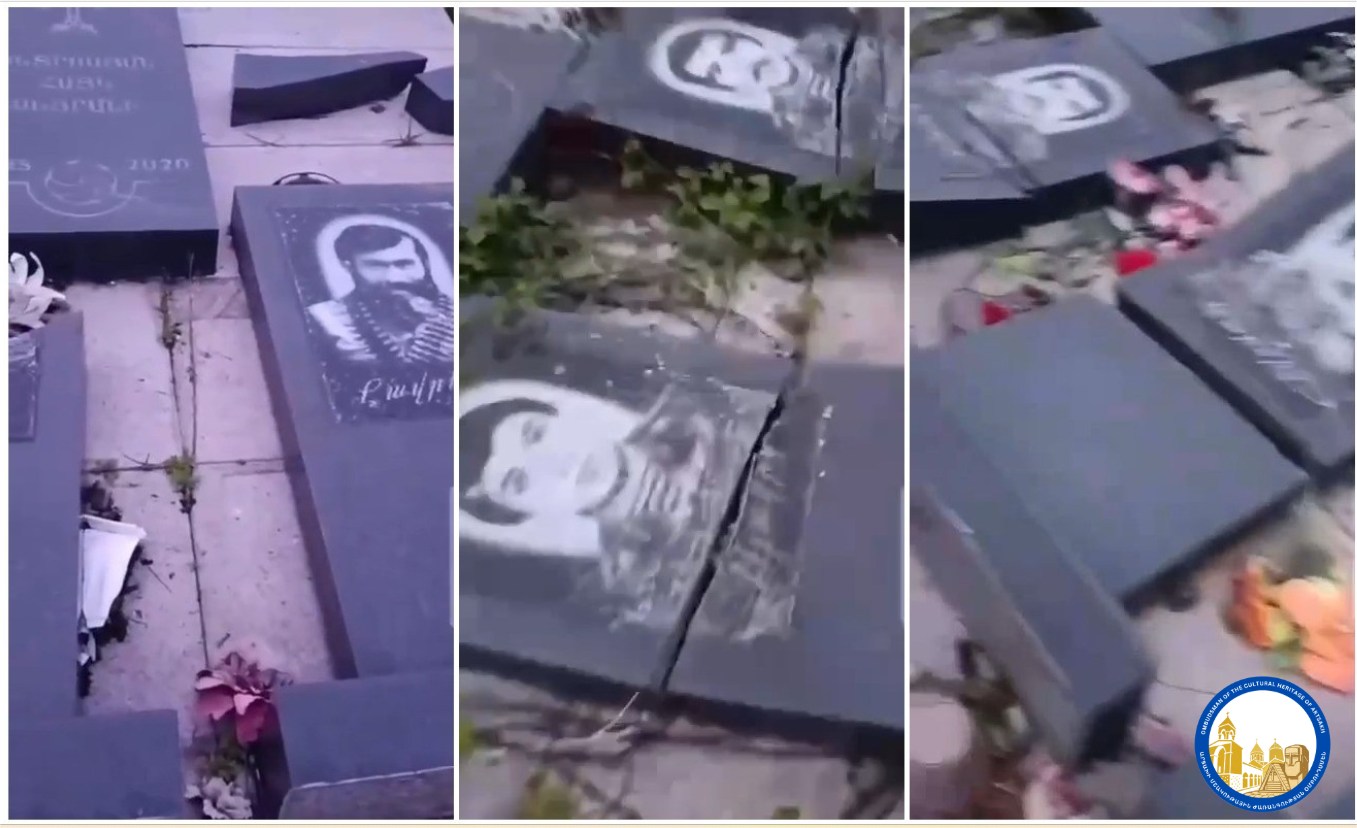
As a result of ongoing monitoring of social media platforms, it has become evident that the latest target of vandalism by the Azerbaijani authorities is the cemetery of fallen freedom fighters in the village of Vaghuhas, located in the Martakert region of the temporarily occupied Republic of Artsakh. The examination and analysis of a video circulated within the Azerbaijani social media sphere, viewed in the context of cultural heritage destruction, ethnic hatred, and grave violations of international humanitarian law, reveal a number of deeply alarming and condemnable manifestations.
First and foremost, the incident clearly demonstrates elements of ethnic and religious targeting. The Armenian-language inscriptions on the gravestones, as well as the portraits of the fallen freedom fighters, unequivocally indicate that the target was not merely a cemetery, but rather a site of profound Armenian identity, national memory, and spiritual heritage. This is not an ordinary act of vandalism, but a deliberate action rooted in ethnic hatred, aimed at erasing the Armenian presence and obliterating historical memory.
The actions documented in the video are marked by exceptional cynicism and desecration. The individual filming the footage intentionally walks across gravestones, stands on the portraits of the deceased, strikes and defiles them. Such conduct constitutes not only physical damage to graves, but also a deliberate insult to the memory of the fallen, the sanctity of burial, and human dignity itself. These actions stand in direct contradiction not only to international legal norms, but also to the most fundamental principles of universal human morality.
The video further reveals numerous shattered, cut, displaced, and damaged gravestones, indicating that the cemetery has been subjected to systematic and deliberate destruction. The scale and nature of the damage point not to an isolated incident, but to a policy of intentional eradication of cultural heritage. Such actions against Armenian cultural and memorial sites in the territories temporarily occupied by the dictatorial regime in Baku have long assumed a continuous and systematic character.
Particularly dangerous and condemnable is the element of psychological terror embedded in these acts. The recording and dissemination of the footage on social media platforms, alongside the Azerbaijani-language expressions heard in the video, demonstrate that the objective extends beyond the destruction of traces of Armenian cultural presence. It is also intended to exert psychological pressure upon the relatives of the fallen, the forcibly displaced Armenians of Artsakh, and Armenian society as a whole. This constitutes an overt attempt to cultivate humiliation, fear, and a sense of vulnerability, while simultaneously serving propagandistic purposes.
Given the fact that the footage may have a severe psychological impact on the relatives of the fallen freedom fighters and on the wider public, we are refraining from publishing it. The video is being preserved in the archive of the Office of the Ombudsperson for the Cultural Heritage of Artsakh as factual evidence of yet another criminal act committed against Armenian cultural heritage.
It must be emphasized that this is not the first recorded case of desecration of the memory of those who sacrificed their lives in defense of the homeland in the village of Vaghuhas. As early as January 5, 2024, our partner organization, the State Service for the Protection of the Historical Environment of Artsakh, reported that Azerbaijani soldiers had destroyed a khachkar erected in 2021 in memory of Mkhitar Aghabekyan, who was killed during the large-scale war unleashed by Azerbaijan against Artsakh in 2020. The khachkar, located near the village roadside, had been created by sculptor Yura Mangasaryan (https://www.aravot.am/2024/01/05/1392100/… ). This fact once again demonstrates that the actions directed against Armenian memory and cultural presence are neither accidental nor isolated occurrences.
The Azerbaijani authorities, in the temporarily occupied territories of Artsakh, continue with particular brutality and consistency to destroy and desecrate monuments and cemeteries commemorating heroes who perished defending their homeland. These actions have already transcended the boundaries of isolated acts of vandalism and evolved into a systematic state-level policy aimed at eliminating Armenian historical and cultural heritage and erasing national memory. More than a dozen similar cases have already been documented across various settlements of Artsakh, attesting to the ongoing and deliberate process of cultural genocide.
The silence and inadequate response of the international community continue to contribute to an atmosphere of impunity. Yet actions directed against cultural heritage, sacred sites, and cemeteries must receive clear political, legal, and moral condemnation. When the graves of the fallen and sites of national memory are targeted, it is not only the rights of one people that are endangered, but also the universal values upon which the existence of the civilized world is founded.
Hovik Avanesov
Cultural Heritage Ombudsman of Artsakh, Vice President of the Azgayin (National) Cultural-Historical NGO
orer.eu