
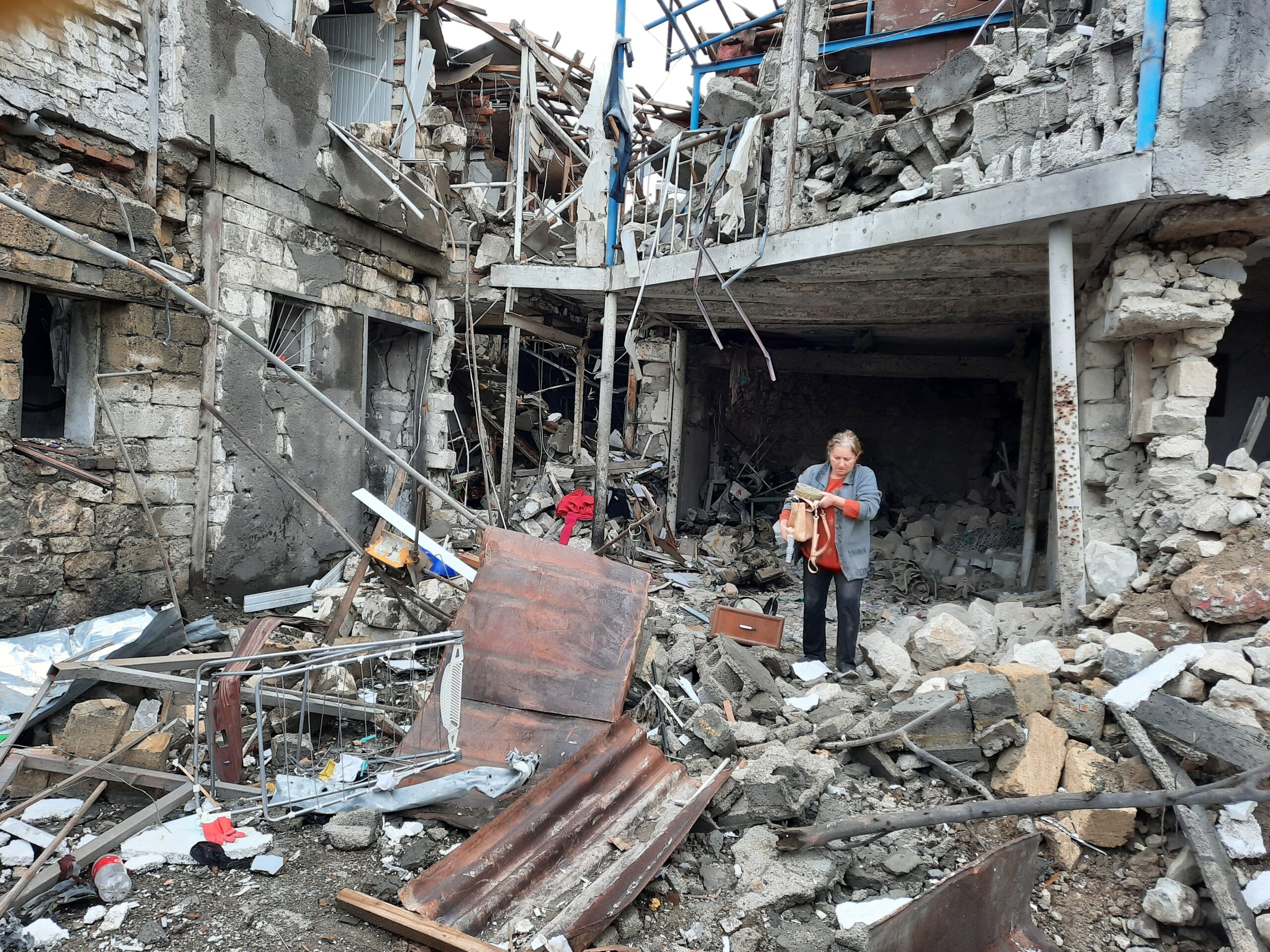
On September 27, 2020, at 07:10 a.m., the Turkish-Azerbaijani terrorist tandem unleashed a large-scale, premeditated war against Artsakh. From the very first moments, the armed forces of Baku’s dictatorial regime targeted the civilian population and vital infrastructure. Cities and villages were shelled and bombed, peaceful citizens-including children-were killed and injured. A number of servicemen were brutally tortured, while internationally prohibited weapons were deployed on the battlefield.
Hospitals also came under the strikes of the Turkish–Azerbaijani criminal tandem, including the newly built maternity hospital in Stepanakert, which was deliberately targeted twice. Schools, cultural centers, and historical–cultural monuments were attacked as well. Sacred sites embodying the memory and identity of peoples were systematically destroyed. On October 8, 2020, using precision-guided weapons, Azerbaijani armed forces twice struck the Holy All Savior Ghazanchetsots Church in Shushi on the same day, wounding representatives of international media.
All of this constitutes clear examples of war crimes, which have no statute of limitations under the Convention on the Non-Applicability of Statutory Limitations to War Crimes and Crimes Against Humanity, adopted in Geneva on November 26, 1968. Article 1 of the Convention explicitly states that no statutory limitation, regardless of the date of commission, shall apply to the following crimes:
( a ) War crimes as they are defined in the Charter of the International Military Tribunal, Nürnberg, of 8 August 1945 and confirmed by resolutions 3 (I) of 13 February 1946 and 95 (I) of 11 December 1946 of the General Assembly of the United Nations, particularly the “grave breaches” enumerated in the Geneva Conventions of 12 August 1949 for the protection of war victims;
( b ) Crimes against humanity whether committed in time of war or in time of peace as they are defined in the Charter of the International Military Tribunal, Nürnberg, of 8 August 1945 and confirmed 2 by resolutions 3 (I) of 13 February 1946 and 95 (I) of 11 December 1946 of the General Assembly of the United Nations, eviction by armed attack or occupation and inhuman acts resulting from the policy of apartheid , and the crime of genocide as defined in the 1948 Convention on the Prevention and Punishment of the Crime of Genocide, even if such acts do not constitute a violation of the domestic law of the country in which they were committed (https://www.un.org/…/Doc.27_convention%20statutory… ).
In 2022, under the false pretext of environmental concerns, the Baku regime blocked the lifeline- the Berdzor Corridor-effectively besieging Artsakh from Armenia and the outside world. According to former Chief Prosecutor of the International Criminal Court Luis Moreno Ocampo, this amounted to a genocidal act of starvation. The blockade led to a severe humanitarian catastrophe.
In September 2023, the Turkish–Azerbaijani terrorist tandem launched yet another large-scale war against the already fully blockaded Republic of Artsakh, seizing the entirety of the region. The Armenians of Artsakh were forcibly displaced from their ancestral homeland. This was not only an act of ethnic cleansing but also a new stage of genocide.
Following the occupation of Artsakh, the dictatorial regime of Azerbaijan embarked on the systematic destruction of Armenian cultural heritage. Within just a few years, this cultural genocide has become one of the most extensive and aggressive crimes of the 21st century. Churches, khachkars , cemeteries, monuments, memorial complexes, residential districts, entire settlements, and other cultural assets are being destroyed, desecrated, or appropriated. Baku is erasing all traces of the Armenian presence.
All this is happening under the conditions of the criminal inaction of the international community. The UN, OSCE, EU, and other institutions have limited themselves to ceremonial statements, effectively legitimizing Baku’s terrorist policy in practice. The absence of international justice does not restrain but rather encourages the Aliyev regime to commit new crimes.
The genocide perpetrated against Artsakh and the systematic destruction of its cultural heritage must become grounds for not only legal but also political accountability in order to restore justice. The crimes committed against the Armenian people will never be subject to any statute of limitations.
Artsakh Cultural Heritage Ombudsman Hovik Avanesov
#OmbudsmanoftheCulturalHeritageofArtsakh