

Rescuing Armenian Culture from the 19th Century: A Report on Marc Nichanian Visiting the Department of Armenian Studies at Pázmány Péter Catholic University, Budapest
Marc Nichanian, the preeminent diaspora Armenian philosopher, critic and translator, visited Budapest at the invitation of the Department of Armenian Studies at Pázmány Péter Catholic University during the first week of November, 2024. Professor Nichanian gave a lecture in English on November 5 and conducted a two-day workshop in Armenian with the Armenian Studies students on November 6 and 7.
Professor Nichanian’s lecture in English focused on the transition from the pre-modern (17th-18th centuries) imperial system of domination to the modern (19th-20th centuries) national configuration of sovereignty with profoundly catastrophic consequences. While the latter can be exposed externally by analyzing the experience of survivors of genocide, internally sovereignty marks itself by refusing the possibility of being a “binational” and by denying exile the possibility of being a tradition. It is this that Amnon Raz-Krakotzkin describes in his book Exile and Sovereignty: Judaism, Zionism and Binational Thought (original in Hebrew, with a 2007 French translation). But what sovereignty registers internally can also be brought to light with the works of the most prominent Western Armenian novelist and critic Hagop Oshagan (1883-1948). Professor Nichanian’s lecture interpreted Oshagan’s texts, including his unfinished novel Remnants, by posing the following question: what comes to destroy from within the sacrificial system of the Ottoman Empire? Realizing that the answer to this question is both absolute subjugation as well as the very idea of modern sovereignty, necessarily mononational, it is imperative to wonder as to what sovereignty still keeps from the violence of the sacrificial empire. This way perhaps the secret inner logic of sovereignty can be exposed, without for all that hoping that sovereignty will be able to recognize it. At stake is understanding the principle of modernity as well as the reasons for and possibilities of developing a culture in exile.
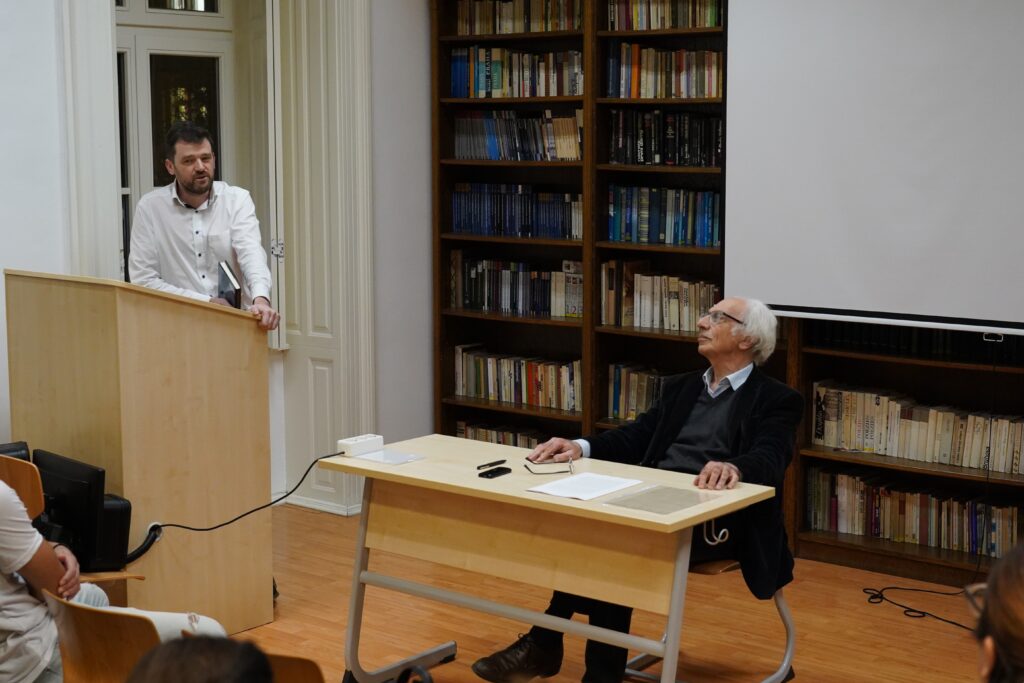
As for the two-day workshop which Professor Nichanian offered in Armenian, it developed critical reflections on the emergence of philology. It is well known that much of the historical, social scientific and cultural knowledge production of the 19th century owes its existence to the advent of the discipline of philology in Europe at the turn of that century, with a global reach that is hard to exaggerate. What is perhaps less known is that philology itself crystallized at the confluence of Orientalism, the critique of which was aptly inaugurated by Edward Saïd’s eponymous book, and the creation of the concept of mythological religion. While philological Orientalism gave rise to the figure of the native at the heart of modern national ideologies, the concept of mythological religion secured a space for further creating or even producing the nation by identifying with and privileging Indo-European religions over Semitic ones. And yet, the highly intriguing links between the two formative strands of philology — Orientalism and the consolidation of the concept of mythological religion — have not been the subject of explicit reflection yet. Professor Nichanian’s workshop addressed this gap by introducing, reading from and discussing the works of the likes of F. Lucas Injijian, Khachatour Abovian and Garegin Srvandztiants as well as Friedrich Schelling, Mkrtich Emin and Daniel Varoujan. In doing so, this workshop strove to develop a renewed understanding of philology as well as cast a new light on the inner workings of the modern Armenian experience.
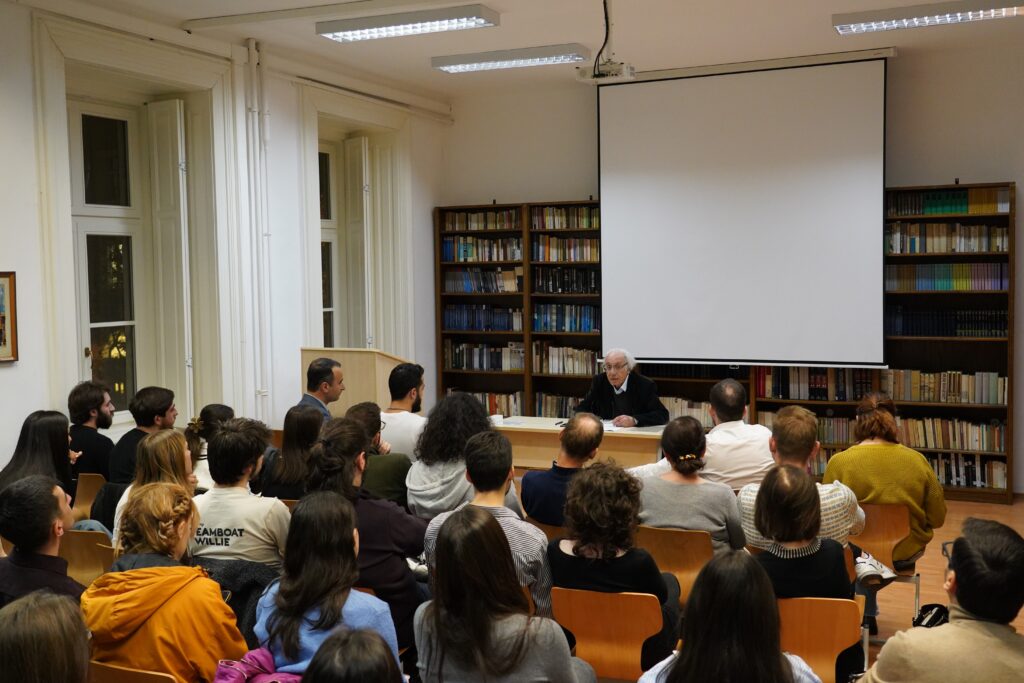
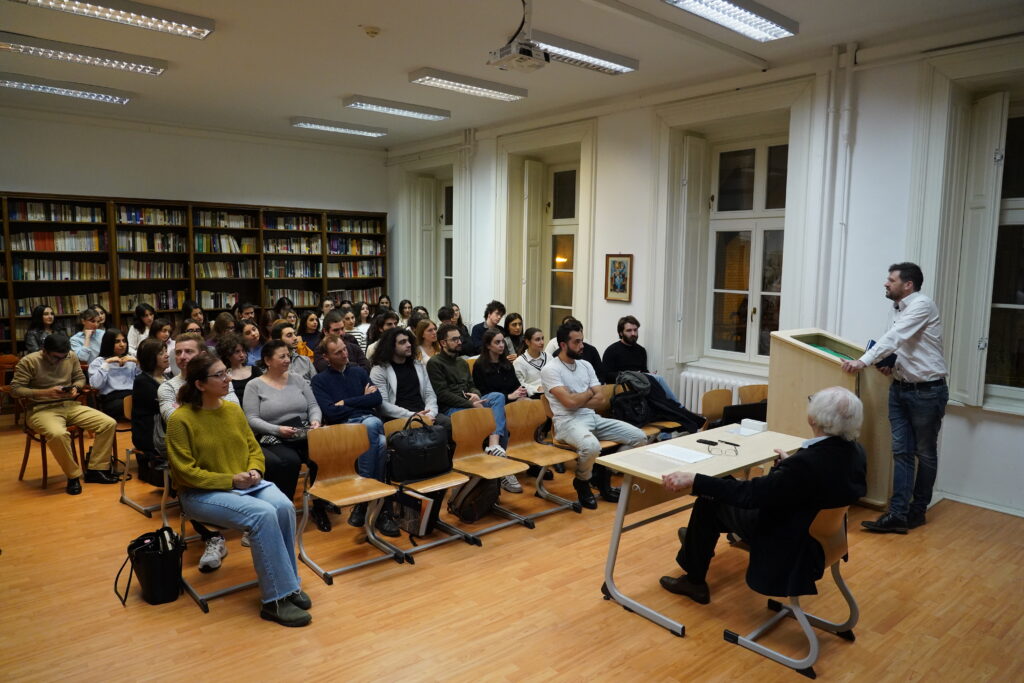
Additionally, Professor Nichanian became acquainted with the students of the Armenian Studies Department as well as members of the Armenian community in Budapest by having two evening meetings at the Armenian Cultural Center in District V. These meetings were particularly informative for everyone. Last but not least, Professor Nichanian visited the Armenian Catholic Church in Budapest. With the guidance of Father Mashdots Zahterian, Professor Nichanian was introduced to the rich history, archive and material heritage of Armenians from Budapest as well as Transylvania. The need and desire was expressed for the establishment in the near future of a museum next to Budapest’s Armenian Catholic Church.

It is worth informing the reader that Professor Nichanian has sustained an intensely generative dialogue between contemporary thought and modern and early-modern Eastern and Western Armenian literatures, in their nation-state and diasporic configurations. Born in France and educated in some of its finest universities, he has been a Professor of Armenian Studies at Columbia University, New York City from 1996 to 2007. Nichanian has also taught at UCLA, the Haigazian University, Beirut, and the Sabanci University, Istanbul, and has been lecturing extensively in Armenia and around the world. Key volumes from him available only in their original language are Le Roman de la Catastrophe (MētisPresses, 2008) and Le Sujet de l’histoire. Vers une phénoménologie du survivant (Lignes, 2015) in French, and Պատկեր պատում պատմութիւն,volumes 1 and 2 (Aktual Arvest, Johannissyan Institute, 2015, 2016) and recently Թարգմանական դամբանական (Armenian Book Center, 2024) in Western Armenian. From Professor Nichanian the following books have been published in English: Writers of Disaster: Armenian Literature in the 20th Century, Volume One: The National Revolution (Taderon Press, 2002), The Historiographic Perversion (Columbia University Press, 2009), translated by Gil Anidjar, and Mourning Philology: Art and Religion at the Margins of the Ottoman Empire (Fordham University Press, 2014), translated by G.M. Goshgarian and Jeff Fort. In English Professor Nichanian has also edited, in collaboration with Vartan Matiossian, as well as contributed to, the collected volume Yeghishe Charents: Poet of Revolution (Mazda Publishers, Inc., 2003).Furthermore, since 1980, he has been publishing GAM (ԿԱՄ) in Western Armenian, a literary philosophical review that has brought critical rigor to Armenian culture. All along the way, Professor Nichanian has been translating from German, French and Italian into Western Armenian, as well as introducing with comprehensive scholarly reflections the works of Nietzsche, Freud, Benjamin, Blanchot, Bataille, Foucault, Agamben, Jean-Luc Nancy, Antoine Berman and Derrida.
Dr. Karen Jallatyan
Postdoctoral Researcher
The Leibniz Institute for the History and Culture of Eastern Europe (GWZO), Leipzig
Lecturer, Member of Doctoral School
Department of Armenian Studies
Pazmany Peter Catholic University
Budapest, Hungary