
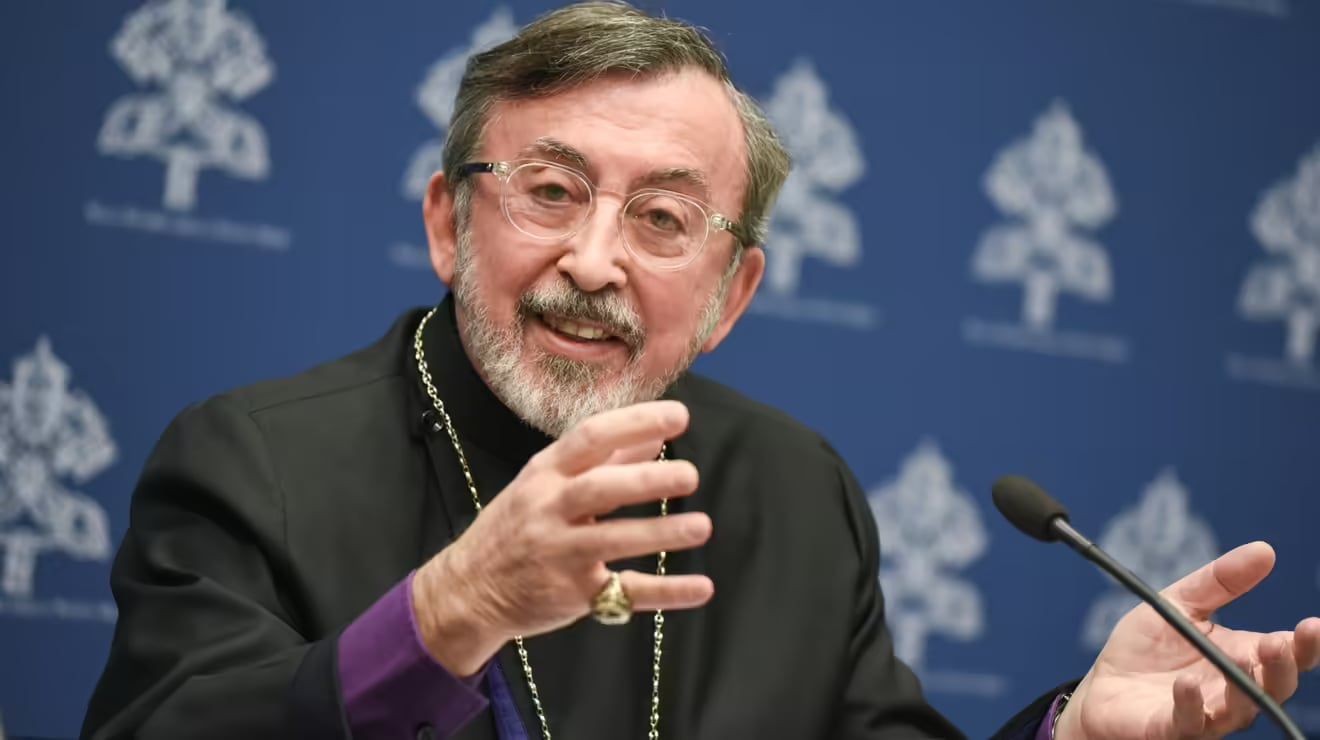
By Archbishop Khajag Barsamian
The Armenian people are living through a historic turning point. For the first time in centuries, we have an enduring and independent Republic of Armenia. Yet roughly three-quarters of the Armenian Apostolic faithful live outside its borders, in a vast and diverse diaspora.
This new reality raises an urgent but often confused question: What is the proper role of the Armenian Apostolic Church, and what is the proper role of the state?
Armenian identity and Christian faith have been tightly woven together. Our medieval writers often spoke of God and homeland in the same breath. This bond helped Armenians survive foreign rule, genocide, and dispersion.
But what helped us survive statelessness can easily create confusion in a modern republic.
Today, the Mother See of Holy Echmiadzin stands on the territory of a sovereign Armenian state. The Catholicos of All Armenians resides in Armenia. Yet most Armenians who look to Etchmiadzin as their spiritual home live abroad. Is the Church mainly the religious arm of the Republic of Armenia? Or is it a global spiritual body for Armenians everywhere, with a mission that cannot be reduced to any one state?
In the Catholic world, the Holy See (the Vatican) and the State of Italy eventually defined their relationship clearly (Lateran Treaty 11 February, 1929): one is a spiritual center with a worldwide flock; the other is a nation-state with its own political responsibilities. Armenia faces a similar need for clarification, adapted to our own history and circumstances.
Such clarity begins with a few basic principles.
First, the Armenian Apostolic Church has a spiritual and moral mission, not a political one. Its core tasks are to preach the Gospel, celebrate the sacraments, form conscience, comfort the suffering, and preserve Armenian Christian culture and memory. It has every right — and sometimes the duty — to speak on moral questions that affect society: justice, corruption, dignity, war and peace, the protection of the weak. But it is not a political party and should not be turned into one.
Second, the Republic of Armenia is a secular state. That should not mean an anti-religious state. It means a government that serves all citizens — believers and non-believers, Apostolic and other—without imposing or enforcing a particular theology. The state must guarantee freedom of conscience, equality before the law, and protection of human rights.
At the same time, a mature secularism can recognize the special historical role of the Armenian Apostolic Church in the life of the nation, and cooperate with it in areas like education, social services, and cultural preservation—within clear legal boundaries.
Why, then, are tensions so high?
Part of the answer lies in expectations formed in another era. For centuries, when Armenia had no state, the Church often acted as the main organized Armenian institution: mediator, educator, protector, diplomat. Some still expect it to play that political role. Others, reacting against this, demand that the Church remain silent in all public matters. Both positions misunderstand the difference between partisan politics and moral witness.
Another part of the answer is politicization. In today’s heated atmosphere, political actors sometimes try to use Church symbols and language to advance their own agendas — or attack the Church to weaken their rivals. This harms both the Church’s spiritual credibility and the quality of democratic debate.
Finally, there is a gap between perspectives in Armenia and in the diaspora. For many in the diaspora, the Church is their primary national institution. For many inside Armenia, it is one institution among others, operating within a fragile and contested political environment. Without careful listening, these different experiences feed mutual frustration.
How do we move from confusion to clarity?
One path is to follow, in our own way, what other states and churches have done: publicly define the relationship between Church and state. That could mean:reaffirming the independence of the Church in spiritual and internal matters;confirming the secular nature of the Republic and its neutrality toward all faiths; recognizing, in law, the unique historical and cultural role of the Armenian Apostolic Church; setting rules to prevent the misuse of Church structures for partisan purposes; creating regular, transparent channels of dialogue between state and Church leadership.
None of these alone would resolve all conflict. Disagreements would remain — and they should, in a free society. But it would reduce the temptation to turn every dispute into an existential struggle between “old Armenia” and “new Armenia,” or between “religion” and “progress.”
In a time of serious national challenges—security threats, social hardship, mass emigration, and unresolved trauma — Armenia needs both a competent state and a credible Church. The state must focus on justice, security, and the material well-being of citizens. The Church must focus on faith, moral formation, hope, and identity. They serve the same people, but in different ways.
Armenian Christianity has always combined patriotism and piety in a distinctive way. That heritage should not be a weapon in a power struggle. It should be a source of wisdom as we learn, perhaps for the first time, how to live as citizens of a modern republic and as heirs of an ancient Christian people.
Clarifying the respective roles of Church and state in Armenia will not diminish either institution. Done well, it will enable both to serve more honestly and more effectively, ensuring that neither political power nor spiritual authority is abused. In this way, the Armenian people-at home and throughout the diaspora-can face the future with clearer minds and steadier hearts. This important mission can be accomplished through a strong partnership amongst the leaders of Church and State, committed to a moral theory that safeguards the well-being of our people both in the homeland and in the diaspora.
orer.eu